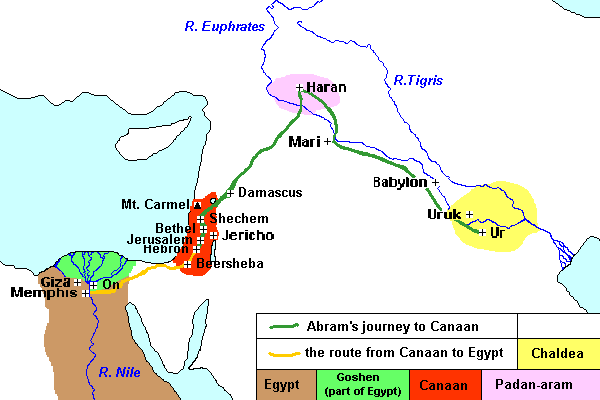
The story of Abraham has fascinated people for centuries. Abraham is considered the father of the Jewish people and is revered by Christians and Muslims alike. But for many years, scholars and historians have debated whether the story of Abraham is based on fact or fiction.
Fortunately, there is tangible evidence that Abraham’s birthplace and hometown did exist. The Bible tells us that Abraham was born in the city of Ur, and today, the ruins of Ur can be found in Mesopotamia, in what is now southern Iraq. Sir Leonard Wooley’s famous excavations at Ur have shown that it was a prosperous trade city around 2000 BC, the time when Abraham is believed to have lived.
The book of Genesis tells us that Abraham’s father, Terah, moved his family to Haran, a city in the northwestern portion of Mesopotamia. And excavations at Haran have proven that the city was abandoned around 1800 BC, which fits with the timeline of Abraham’s life.
But perhaps the most exciting discovery was made in 1975, in the ancient city of Ebla, in what is now Syria. Archaeologists uncovered 17,000 clay tablets that provided tangible evidence of the names of several people mentioned in the Bible, including Isaac, Jacob, and Abraham, as well as the names of Abraham’s father, grandfather, and great-grandfather. These names are also known from other sources in Northwest Mesopotamia, in both Babylonian and Old Assyrian texts.
So while the story of Abraham maybe thousands of years old, the evidence found in Ur, Haran, and Ebla proves that Abraham was a real person who lived in the places mentioned in the Bible.
Part 2 – Living in Egypt
Leaving Shechem, Abram journeyed to Bethel where he built an altar to the Lord. Then he continued towards Negev. Since there was a huge famine in the land, Abram went to Egypt to live there for a while. Fearing for his life because of his beautiful wife Sarai, Abram told everyone she was his sister. The pharaoh of the land desired Sarai and wanted to make her his wife. He gave Abram great wealth, including cattle and servants. However, God afflicted the pharaoh with a terrible disease, and he realized it was because of Sarai. He summoned Abram and asked him to take Sarai and his possessions and leave the land. Abram returned to Bethel with all his acquired wealth.
Abram and his nephew Lot had amassed so much wealth and servants that they could no longer journey together. They parted ways, with Lot heading toward the flourishing plain of Jordan and pitched his tents near Sodom. Abram settled near the great trees of Mamre in Hebron. There, he built an altar to The Lord.
One day, Abram had a vision and asked the Lord if his servant Eliezer would inherit his possessions since he had no son of his own yet. But the Lord took him outside and he said “Look up at the sky and count the stars …so shall your offspring be”. And Abram believed the Lord.
But Sarai got anxious realizing that it had been 10 years since they had left Haram and that Abram was 85 years old. She had an Egyptian maidservant called Hagar. She gave her to Abram so that she could have offspring through her. Hagar became pregnant by Abram and she bore a son and named him Ishmael.
When Abraham was 99 years old, the Lord appeared to him and made a covenant with him. He told Abram that from that day onwards he will be called Abraham and his wife will be called Sarah. The Lord promised that Sarah would bear a son, Isaac and that he would bless Isaac and establish a covenant with him and his descendants. He also told Abraham that all males in his household should be circumcised as a sign of the covenant. Abraham obeyed God and all men in his household were circumcised.
As promised, Sarah bore a son named Isaac when Abraham was 100 years old, and the Lord blessed him. The Lord instructed Abraham to send away Hagar and Ishmael, as he would bless Isaac’s generation. It was through Isaac that the Israelites (Jews) were born and blessed by God.
Lorem Ipsum is simply dummy text of the printing and typesetting industry. Lorem Ipsum has been the industry's standard dummy text ever since the 1500s, when an unknown printer took a galley of type and scrambled it to make a type specimen book.