Ruth: A Courageous Journey of Unwavering Faith and Love
There lived a man named Elimelech in Bethlehem. A severe famine struck the land that brought about a scarcity of food and the people suffered greatly. Elimelech took his wife Naomi and their two sons, left their homeland of Bethlehem and went to live in the neighboring country of Moab. Sadly, Elimelech passed away, leaving Naomi as a widow. Naomi’s two sons, Mahlon and Kilion married the Moabite women named Orpah and Ruth.Moabites are the descendants of Lot, who was the nephew of the biblical patriarch Abraham. (Genesis 19:37)
However, after living in Moab for about ten years, tragedy struck again. Both Mahlon and Kilion died, leaving Naomi without her husband and her two sons. Hearing that the famine in Bethlehem has ended, Naomi decides to return home and encourages her daughters-in-law to remain in Moab and start new lives. Orpah tearfully bids farewell, but Ruth clings to Naomi, expressing her undying love, loyalty and commitment. Ruth’s famous words to Naomi were, “Where you go, I will go, and where you stay, I will stay. Your people will be my people, and your God my God,”. This decision showcased her deep devotion to Naomi and her willingness to leave behind her familiar homeland and embrace a new life in a foreign land. Her words reflected her commitment not only to Naomi but also to the God of Israel.
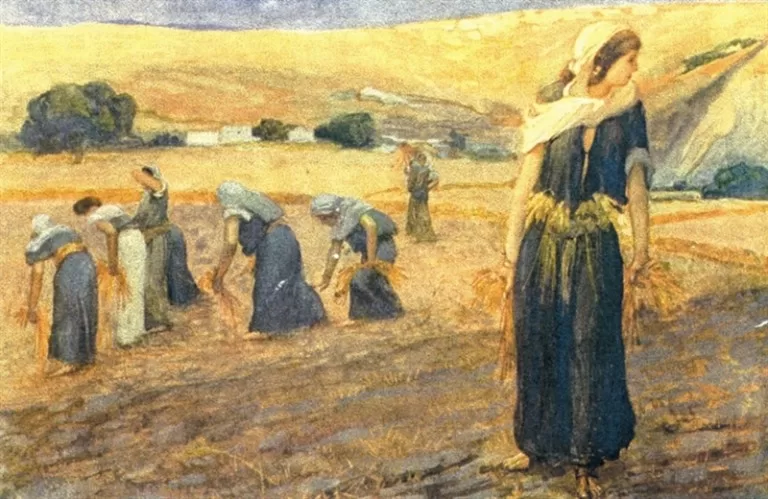
Ruth and Naomi journey back to Bethlehem, where they arrive during the barley harvest. Ruth takes the initiative to go glean in the fields to provide for herself and Naomi. By divine providence, she finds herself in the fields of Boaz, a wealthy and upright man who happens to be a relative of her father-in-law Elimelech.
Boaz notices Ruth’s hard work and learns of her loyalty to Naomi. Impressed by her character, he extends his protection and kindness towards her. Boaz instructs his workers to allow Ruth to glean freely in his fields and even ensures she has enough food to eat.
Naomi recognizes Boaz’s significance as a potential “kinsman redeemer,” someone who could redeem the family’s land and secure their future. Naomi instructs Ruth to approach Boaz on the threshing floor at night, where she uncovers his feet and lies down. Startled, Boaz awakens and finds Ruth at his feet. In this encounter, Ruth expresses her desire for Boaz to act as her kinsman redeemer. Boaz acknowledges her virtue and promises to settle the matter, but informs her that there is a closer relative who has the first right of redemption.
Boaz meets with the closer relative in the presence of witnesses and explains the situation. However, the relative declines to redeem the land and Ruth. Boaz gladly fulfills his role as the kinsman redeemer by marrying Ruth, which brought joy and restoration to Naomi’s life. Ruth soon conceived and gave birth to a son named Obed, who became the grandfather of King David, a significant figure in Israel’s history.
The story of Ruth showcases themes of loyalty, faithfulness, redemption, and God’s providence. It is a tale of a foreign woman’s remarkable commitment, which leads to unexpected blessings and a place in the grand narrative of the salvation history.
What does a Kinsman Redeemer mean?
In the cultural context of ancient Israel, the concept of a kinsman redeemer held significant importance. The term “kinsman redeemer” comes from the Hebrew word “go’el,” which refers to a close relative who has the legal responsibility to act on behalf of a family member in need. The role of the kinsman redeemer had various aspects, including the following:
Redemption of Property: One of the primary responsibilities of a kinsman redeemer was to redeem or buy back property that belonged to a relative who had fallen into poverty or had to sell it due to financial difficulties. This ensured that the family’s inheritance and land holdings remained within the tribe and clan.
Levirate Marriage: In cases where a man died childless, it was the duty of the kinsman redeemer to marry the widow of his deceased relative. The firstborn child from this union would be considered the heir of the deceased and would inherit his property, thus ensuring the continuation of the family lineage if the widow had no children. By marrying the widow, the kinsman took on the responsibility of providing for her and any children she might have had with her deceased husband. This prevented the widow from facing destitution or social vulnerability.
Protection and Provision: The kinsman redeemer had a broader responsibility to provide protection, support, and care for the family members in need, particularly widows, orphans, and those who were vulnerable. This extended to offering financial assistance, legal representation, and acting as an advocate on their behalf.
In the book of Ruth, Boaz is portrayed as a kinsman redeemer. After Ruth’s husband (Boaz’s relative) passed away, she and her mother-in-law, Naomi, were left widowed and without much means of support. Boaz stepped into the role of the kinsman redeemer, taking the initiative to redeem the land that belonged to Ruth’s deceased husband, as well as marrying Ruth, thereby preserving the family’s inheritance and providing for their well-being.
The concept of a kinsman redeemer or a similar role is found in various cultures around the world. While the specific terms and customs may differ, the underlying principle of a relative stepping in to provide assistance, support, or protection to family members in need is present in many societies.
Lorem Ipsum is simply dummy text of the printing and typesetting industry. Lorem Ipsum has been the industry's standard dummy text ever since the 1500s, when an unknown printer took a galley of type and scrambled it to make a type specimen book.