

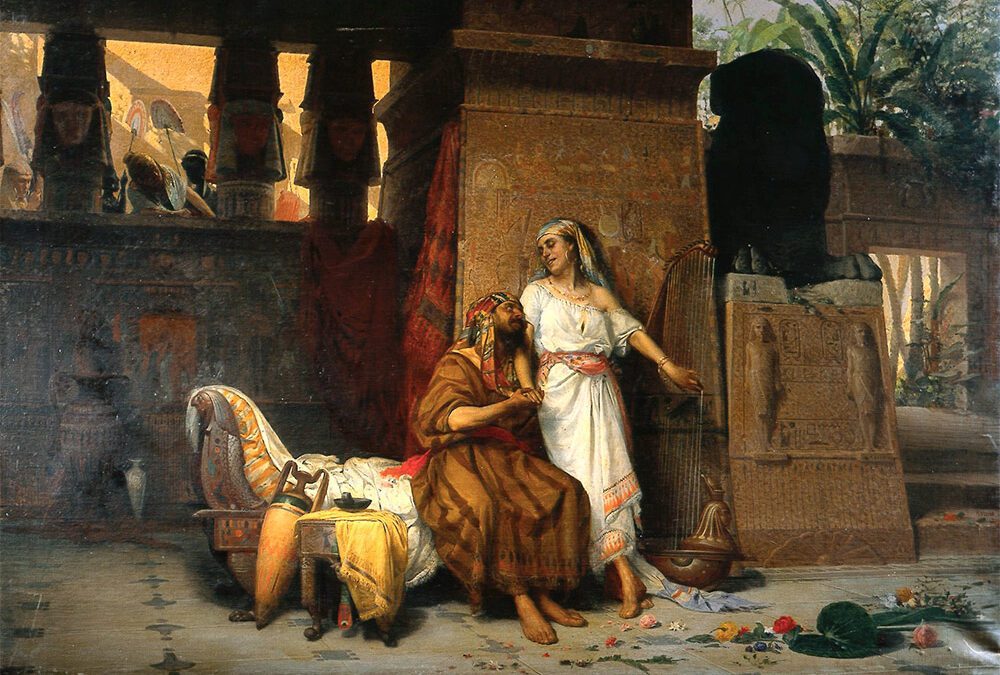
Genesis 12:10-17
The journey that had begun with faith now took a sharp turn as Abram and his household found themselves struggling against a relentless famine in the land. The earth was dry, the crops withered, and the wells ran low. Abram, ever the pragmatist, knew the only place that might offer refuge was Egypt. So, with Sarai, Lot, and their people, he turned southward, heading toward the Nile, where the land remained fertile even in times of drought.
As they neared the borders of Egypt, a knot of worry tightened in Abram’s chest. He had always trusted the Lord, yet now, faced with the uncertainties of a foreign land, doubt began to creep in. He turned to Sarai, his heart heavy with the weight of his fear.
“Sarai,” he said quietly, “I know what a beautiful woman you are. When the Egyptians see you, they will not see a wife—they will see a prize to be claimed. And I know what they’ll do to get to you. They will kill me, and you will be left alone. So, tell them you are my sister. That way, they will treat me well, and I will survive.”
Sarai trusted her husband, though the path he suggested felt laden with uncertainty. In this land of strangers, she would become a sister, only to save Abram’s life. Her loyalty to him was steadfast, even if it meant navigating this treacherous course.
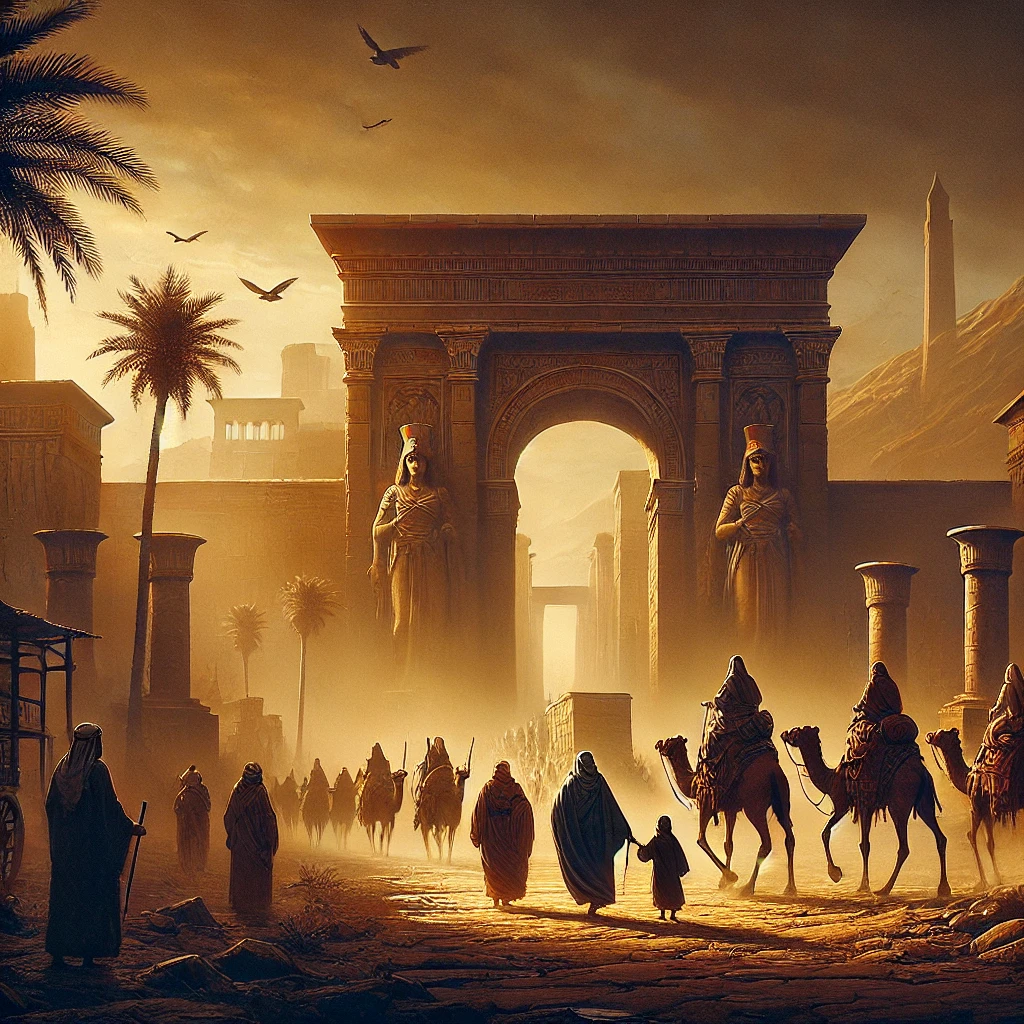
As they entered Egypt, Abram’s worst fears began to unfold. The Egyptians, upon seeing Sarai, marveled at her beauty. Word quickly spread through the palace, and soon, Pharaoh’s officials were praising her before the king. She was taken into Pharaoh’s harem, and Abram, though uneasy, was treated with lavish gifts—sheep, cattle, donkeys, servants, and camels.
But the Lord, ever watchful and protective, did not turn His eyes away from Abram or Sarai. Though they had chosen a path of deception, the Lord’s faithfulness was greater still. A deep and mysterious affliction swept through Pharaoh’s household, striking the king and his servants with disease. The palace became a place of chaos and confusion as the sickness spread. It came upon them swiftly, a shadow upon their health that none could explain. Pharaoh, desperate for answers, sought counsel, and it was then that the truth was revealed. The sickness, it seemed, was no mere coincidence. The Lord had placed it upon Pharaoh’s house because of Sarai.
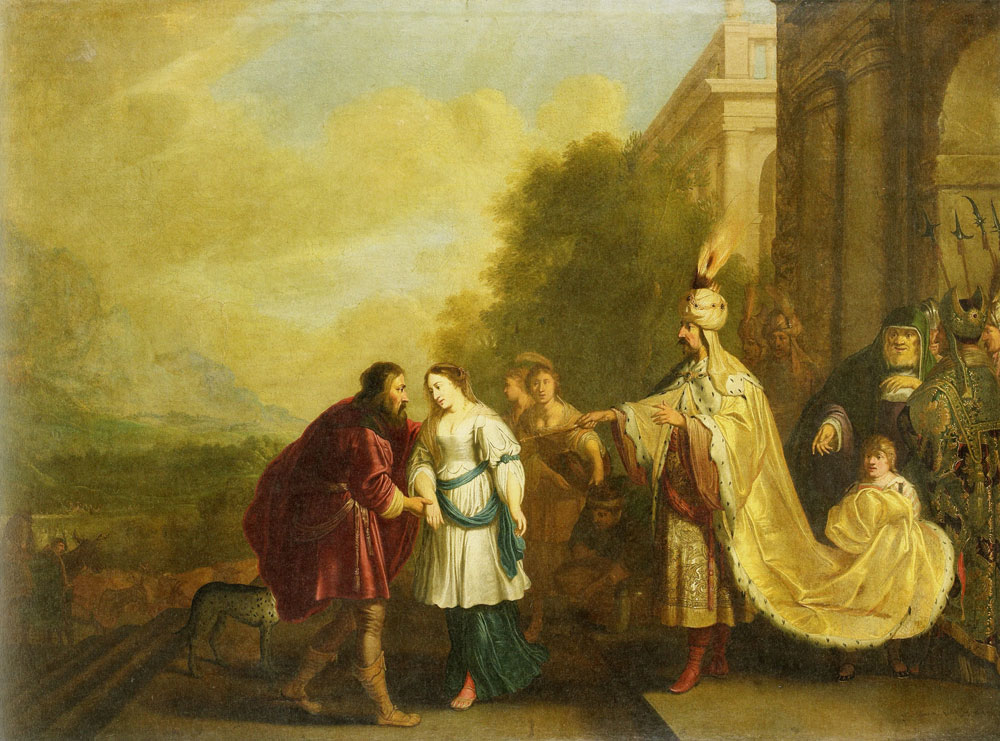
In his confusion and anger, Pharaoh summoned Abram. His voice, sharp with accusation, filled the royal chambers. “What have you done to me?” he demanded. “Why did you deceive me? Why did you tell me she was your sister and not your wife? Do you not know the danger you have brought upon me?”
Pharaoh, realizing that the matter had been settled by divine intervention, turned to his officials and ordered them to return Sarai to Abram. “Take her and go,” Pharaoh commanded.
With that, Abram’s household was hastily ushered out of the palace. Pharaoh ordered his men to see them safely out of the city, ensuring that Abram and Sarai were sent on their way with everything they had acquired—riches, animals, and servants. The deception had been exposed, but it was not Abram who bore the consequences. Instead, the Lord’s hand of protection had kept them safe. Though Abram’s actions had faltered, the Lord’s faithfulness had not.
Reflection
Abram’s journey to Egypt is a profound reminder of human frailty and divine faithfulness. Faced with famine, Abram relied on his own understanding, choosing deception to protect himself in a foreign land. His fear led him to compromise the truth, endangering the very promise God had made to him. Yet, even in Abram’s failure, God’s faithfulness remained unwavering. The Lord intervened, protecting Sarai and preserving His covenant by afflicting Pharaoh’s household.
Abram’s missteps did not nullify God’s plan; instead, they revealed the depth of God’s mercy. Through this experience, Abram was reminded that God’s promises are upheld not by human perfection but by divine grace.
In our own lives, like Abram, we may falter, but God’s steadfast love never fails. He walks with us, even through our failures, leading us back to trust in Him and ensuring His purposes are fulfilled.
Commentary –
Why did Abram devise such a plan?
Ancient writings suggest that Sarai was second only to Eve in her beauty—a fact Abram knew would attract attention, even in a foreign land. Her beauty, however, became the source of Abram’s fear: that Egypt would not see her as his wife but as a treasure to be taken.
In those times, in enemy territory, a man could be killed for his wife. Egypt, in particular, was a land where the law left no room for ambiguity. There was no divorce—only death. To Abram, the situation seemed dire. If Pharaoh desired Sarai, Abram believed he would be killed. Claiming her as his sister, though morally flawed, seemed to Abram the only way to save his life.
However, Abram’s claim was not entirely false—Sarai was his half-sister, the daughter of his father Terah (Genesis 20:12). Such marriages, though undesirable, were practiced in those days but were later explicitly prohibited in the Book of Leviticus (Leviticus 18:9).
It’s important to remember that the Bible recounts the actions of flawed, sinful people and does not necessarily reflect what God would have desired. Abram’s plan reveals his human frailty and fear, underscoring the contrast with God’s perfect and unwavering faithfulness..
Did Abram put the chastity of Sarai on the line?
This question is significant, given the cultural and historical context of Abram and Sarai’s journey to Egypt. Abram’s decision to present Sarai as his sister rather than his wife was driven by fear for his own life. He believed that Pharaoh or his men might kill him to take Sarai if they knew she was his wife, given her renowned beauty and the practices of the time.
However, historical records suggest that when a woman entered a royal harem in ancient Egypt, she would first undergo a lengthy purification period, often lasting several months to a year. During this time, no sexual relations would occur, as the process was both physical and cultural preparation.
In Sarai’s case, her stay in Pharaoh’s palace was abruptly interrupted by divine intervention. The Lord struck Pharaoh and his household with severe diseases, making it clear that Sarai was not to be claimed by the king. Pharaoh, realizing the truth about Sarai, returned her to Abram immediately, understanding the danger of keeping her in his household.
Abram’s decision reflects human frailty and fear, but the outcome highlights a greater truth: God’s faithfulness and protection prevail, even amid human failings. Sarai’s dignity and purity were ultimately safeguarded, not by Abram’s plan, but by God’s sovereign hand, demonstrating His steadfast commitment to His covenant and His people.
How could Sarai, likely around 65 years old, still be considered attractive to Pharaoh?
Remember, we are talking about a time when people lived beyond 100 years, and the definition of beauty might have been different culturally than it is today. Sarai herself lived until 125, and at 65, she was still in her prime. Age had not robbed her of her beauty. While the passage of time had marked her with wisdom, she probably still carried a captivating allure. Her fair and light complexion set her apart from the Egyptians, who were a darker-skinned people.
It was this unique trait that likely caught the attention of the Egyptians, including Pharaoh. The Egyptians, descended from Ham, were not a people typically known for their beauty. Their features often included flat foreheads, high cheekbones, and thick lips, making Sarai’s radiant skin and striking features all the more remarkable in comparison. Though she was past sixty, she had retained much of her youthful beauty, which, along with her complexion, could have made her particularly attractive to Pharaoh and his court.
The Epic Save: Abram’s Fake Out and God’s Backup
